
Hindu Trignometry

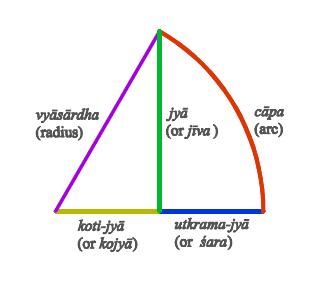
In Hindu Trignometry ( which is derived from Trikonamithi, trikona = triangle and trignon = triangle ), Jya resembles the modern Sine and Koti Jya, the cosine.

But in actuality, Jya is R Sin, that is Radius multiplied by modern sine.

By Jya, Brahmagupta meant 5 degrees of a circle. In Hindu Sine Tables and Tan Tables, the values are given for 5 degrees, 10 degrees, 15 degrees etc so that the Astro Maths students need not bother about using the Indian trignometric and inverse functions. Aryabhata’s sine tables are found to be accurate, when compared to modern sine tables.

In other words, one Zodiacal Constellation, which is 30 degrees is made up of 6 jyas and a total of 72 Jyas constitute the Zodiac.

Koti Jya is R Cos, that is Radius multiplied by modern cosine.

Utkram Jya is the reverse sine, defined as 1- cos x. Since the Reverse sine resembled an arrow, Brahmagupta called it Sara. And since the Arcsine resembled a bow, he called it Chapa.

Bhujajya is radius multiplied by modern sine and bhujachapa is the arcsine. Kotijya is radius multiplied by modern cosine and Kotichapa is arccos. Sparshjya is tan and sparshachapa is arctan.

Aryabhata’s Sine Table was the first ever constructed sine table in the History of Maths.

This is Aryabhata’s Sine Table given for different Kakshyas ( One Kakshya is 3 degrees 45 mins, one eighth of 30 degrees Zodiacal Sign )

Sl. No Angle ( A ) (in degrees, arcminutes) Value in Āryabhaṭa’s numerical notation
(in Devanagari) Value in Āryabhaṭa’s numerical notation (in ISO 15919 transliteration) Value in Arabic numerals Āryabhaṭa’s value of jya (A) Modern value of jya (A)
(3438 × sin (A))

1 03° 45′ मखि makhi 225 225′ 224.8560
2 07° 30′ भखि bhakhi 224 449′ 448.7490
3 11° 15′ फखि phakhi 222 671′ 670.7205
4 15° 00′ धखि dhakhi 219 890′ 889.8199
5 18° 45′ णखि ṇakhi 215 1105′ 1105.1089
6 22° 30′ ञखि ñakhi 210 1315′ 1315.6656
7 26° 15′ ङखि ṅakhi 205 1520′ 1520.5885
8 30° 00′ हस्झ hasjha 199 1719′ 1719.0000
9 33° 45′ स्ककि skaki 191 1910′ 1910.0505
10 37° 30′ किष्ग kiṣga 183 2093′ 2092.9218
11 41° 15′ श्घकि śghaki 174 2267′ 2266.8309
12 45° 00′ किघ्व kighva 164 2431′ 2431.0331
13 48° 45′ घ्लकि ghlaki 154 2585′ 2584.8253
14 52° 30′ किग्र kigra 143 2728′ 2727.5488
15 56° 15′ हक्य hakya 131 2859′ 2858.5925
16 60° 00′ धकि dhaki 119 2978′ 2977.3953
17 63° 45′ किच kica 106 3084′ 3083.4485
18 67° 30′ स्ग sga 93 3177′ 3176.2978
19 71° 15′ झश jhaśa 79 3256′ 3255.5458
20 75° 00′ ङ्व ṅva 65 3321′ 3320.8530
21 78° 45′ क्ल kla 51 3372′ 3371.9398
22 82° 30′ प्त pta 37 3409′ 3408.5874
23 86° 15′ फ pha 22 3431′ 3430.6390
24 90° 00′ छ cha 7 3438′ 3438.0000

Sine Table by courtesy www.wikipedia.org
The Epicyclic Theory of Indian Astronomy

All planets traverse in ellipses and epicycles and this came to be known as the Epicycles Theory.

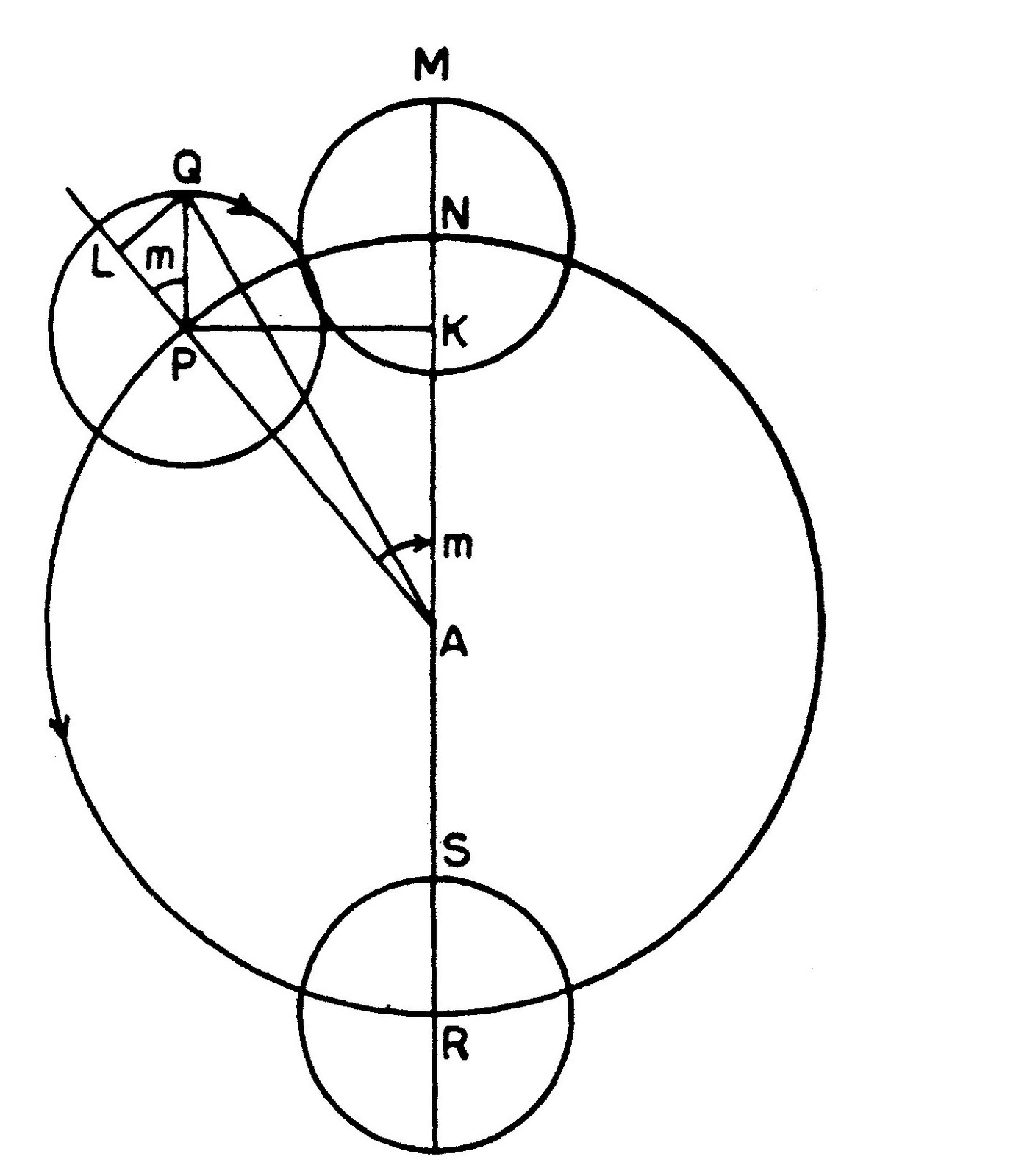
In the above diagram, the circle A is the mean orbit of the planet. P is the mean Position of the planet and the small circle P is the epicycle.

The small epicycles traversed by a planet are calculated and the mandaphala, the equation of center is computed and added if the Manda Kendra is in between 180 and 360 and subtracted if the M K is < 180. Manda Kendra is the angle between Position and Aphelion.

From the perspective of the Epicyclic theory & the Hindu astronomers, the radius of the epicycle was given instead of PQ and the circumferences of the epicycles. Both circumferences and radii are given in degrees, minutes and seconds, so that the equation of the center may be computed in deg min and secs. The epicycle in the case of the Equation of Center is given as Manda Nicha Uccha Vritta.

Manda – Manda Phala or Equation of Center
Uccha – Apogee
Nicha – Perigee

Manda Kriya is a Jya Ganitha Kriya, a trignometric reduction of the mean longitudes and distances of the planets to their heliocentric longitudes and distances.

The Epicyclic Theory of Indian Astronomy

All planets traverse in ellipses and epicycles and this came to be known as the Epicycles Theory.

In the above diagram, the circle A is the mean orbit of the planet. P is the mean Position of the planet and the small circle P is the epicycle.

The small epicycles traversed by a planet are calculated and the mandaphala, the equation of center is computed and added if the Manda Kendra is in between 180 and 360 and subtracted if the M K is < 180. Manda Kendra is the angle between Position and Aphelion.

From the perspective of the Epicyclic theory & the Hindu astronomers, the radius of the epicycle was given instead of PQ and the circumferences of the epicycles. Both circumferences and radii are given in degrees, minutes and seconds, so that the equation of the center may be computed in deg min and secs. The epicycle in the case of the Equation of Center is given as Manda Nicha Uccha Vritta.

Manda – Manda Phala or Equation of Center
Uccha – Apogee
Nicha – Perigee

Manda Kriya is a Jya Ganitha Kriya, a trignometric reduction of the mean longitudes and distances of the planets to their heliocentric longitudes and distances.

The Epicyclic Theory of Indian Astronomy

All planets traverse in ellipses and epicycles and this came to be known as the Epicycles Theory.

In the above diagram, the circle A is the mean orbit of the planet. P is the mean Position of the planet and the small circle P is the epicycle.

The small epicycles traversed by a planet are calculated and the mandaphala, the equation of center is computed and added if the Manda Kendra is in between 180 and 360 and subtracted if the M K is < 180. Manda Kendra is the angle between Position and Aphelion.

From the perspective of the Epicyclic theory & the Hindu astronomers, the radius of the epicycle was given instead of PQ and the circumferences of the epicycles. Both circumferences and radii are given in degrees, minutes and seconds, so that the equation of the center may be computed in deg min and secs. The epicycle in the case of the Equation of Center is given as Manda Nicha Uccha Vritta.

Manda – Manda Phala or Equation of Center
Uccha – Apogee
Nicha – Perigee

Manda Kriya is a Jya Ganitha Kriya, a trignometric reduction of the mean longitudes and distances of the planets to their heliocentric longitudes and distances.

Kranti, the Sun’s declination

The declination of the Sun is computed by the formula

Sin J = Sin L Sin w

where J is the Sun’s declination of that particular date and time, L is the tropical longitude of the Sun and w, the Sun’s maximum declination, which is 23 degrees and 27 minutes.

The Sun’s maximum declination will be reached during Karkyadi ( The First Point of Cancer ) and Makaradi ( The First Point of Capricorn ). At Karkyadi, it will be +23 d 23 m and at Makaradi, it will be -23 d 27 minutes.

And at Meshadi ( The First Point of Aries ) and Thuladi ( The First Point of Libra ), the solar declination will be zero. Days and nights will be of equal duration and hence they are called Equinoxes.

Yada Mesha Thulayo varthathe thada ahoratranam samanani bhavanthi

Kranti, the Sun’s declination

The declination of the Sun is computed by the formula

Sin J = Sin L Sin w

where J is the Sun’s declination of that particular date and time, L is the tropical longitude of the Sun and w, the Sun’s maximum declination, which is 23 degrees and 27 minutes.

The Sun’s maximum declination will be reached during Karkyadi ( The First Point of Cancer ) and Makaradi ( The First Point of Capricorn ). At Karkyadi, it will be +23 d 23 m and at Makaradi, it will be -23 d 27 minutes.

And at Meshadi ( The First Point of Aries ) and Thuladi ( The First Point of Libra ), the solar declination will be zero. Days and nights will be of equal duration and hence they are called Equinoxes.

Yada Mesha Thulayo varthathe thada ahoratranam samanani bhavanthi

Kranti, the Declination of the Sun

The declination of the Sun is computed by the formula

Sin J = Sin L Sin w

where J is the Sun’s declination of that particular date and time, L is the tropical longitude of the Sun and w, the Sun’s maximum declination, which is 23 degrees and 27 minutes.

The Sun’s maximum declination will be reached during Karkyadi ( The First Point of Cancer ) and Makaradi ( The First Point of Capricorn ). At Karkyadi, it will be +23 d 23 m and at Makaradi, it will be -23 d 27 minutes.

And at Meshadi ( The First Point of Aries ) and Thuladi ( The First Point of Libra ), the solar declination will be zero. Days and nights will be of equal duration and hence they are called Equinoxes.

Yada Mesha Thulayo varthathe thada ahoratranam samanani bhavanthi

The Eccentric Theory of Indian Astronomy


We have said in our columns that the Indian astronomers said that the planets revolve around a point different from that of the Earth and Indian Astronomy is heliocentric.

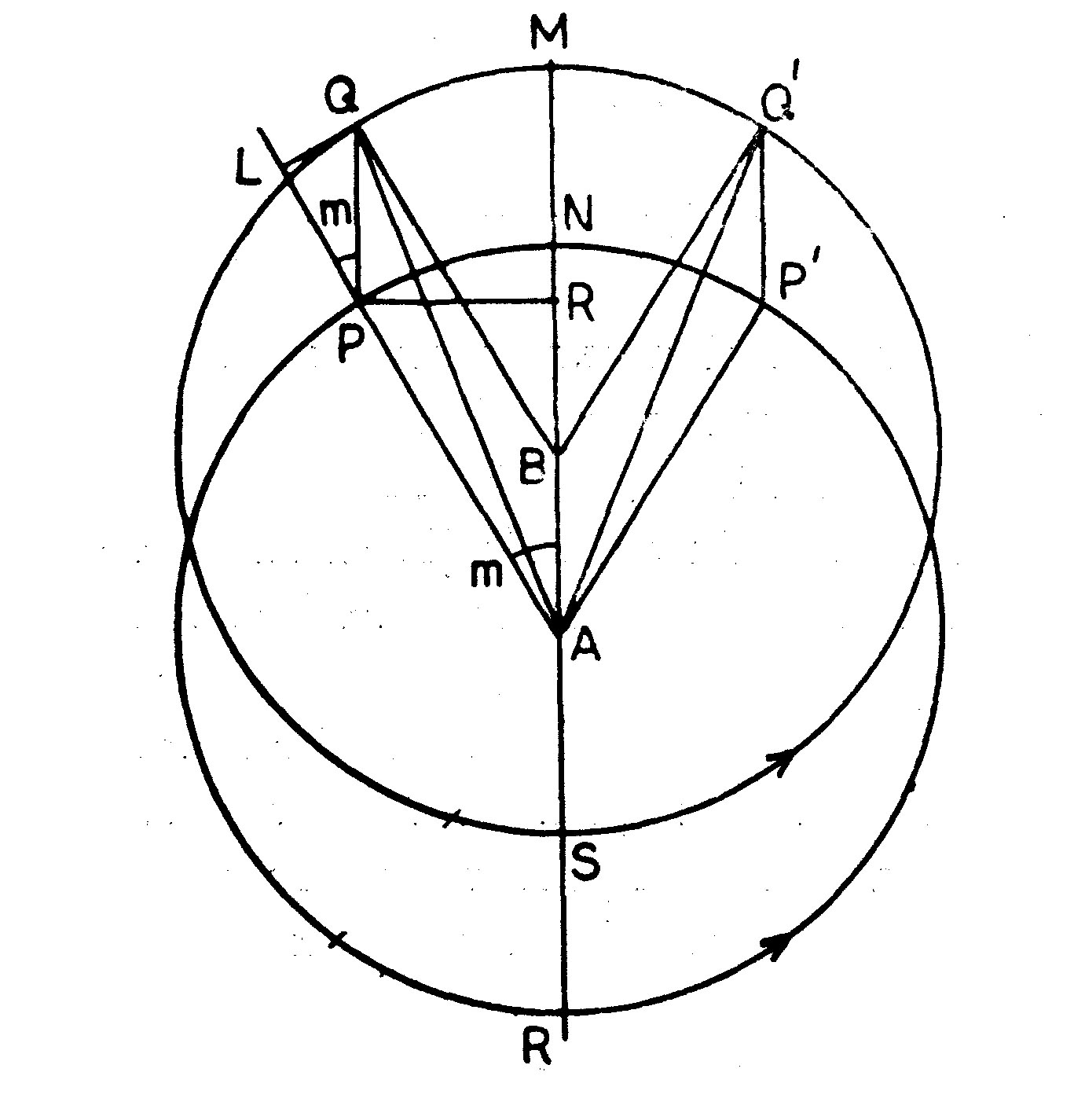
The above diagram depicts the Eccentric Theory and Reduction of the longitude of the planet to the heliocentric coordinate system ( known as Manda Kriya ).

In the above diagram

The angle NAP = Manda Kendra or Mean Anomaly

The Circle A is the mean orbit of the planet
The Circle B is the true orbit

The mean planet moves on the mean orbit, known as the deferent.

When the planet is at N in the mean orbit, he is at M in the eccentric and this is called Mandoccha ( Aphelion ).

When the planet is at R in the mean, he is at S in the eccentric.

M and S correspond to Apogee and Perigee in the case of Manda Phala correction ( otherwise known as the Equation of Center ).

When the planet is at M in the eccentric, the position of the true planet coincides with N, the mean planet and so the Manda Phala correction is Zero.The Equation of Centre at both perigee and apogee becomes zero.

When the Mean Anomaly lies between 0 and 180 degrees, the Equation of Center is negative and this is known in Vedic Astronomy as Meshadi Rinam, Rinam meaning minus. And when it is between 180 and 360, it is additive and it is known in Indian Astronomy as Thuladi Dhanam, dhanam meaning additive.

Anomaly has been defined in Western Astronomy as the angle between position and perihelion. Manda Kendra here is the angle between Position and Aphelion, aphelion being mandoccha. The term manda explains that planets move slower at Aphelion !

The Eccentric Theory of Indian Astronomy


We have said in our columns that the Indian astronomers said that the planets revolve around a point different from that of the Earth and Indian Astronomy is heliocentric.

The above diagram depicts the Eccentric Theory and Reduction of the longitude of the planet to the heliocentric coordinate system ( known as Manda Kriya ).

In the above diagram

The angle NAP = Manda Kendra or Mean Anomaly

The Circle A is the mean orbit of the planet
The Circle B is the true orbit

The mean planet moves on the mean orbit, known as the deferent.

When the planet is at N in the mean orbit, he is at M in the eccentric and this is called Mandoccha ( Aphelion ).

When the planet is at R in the mean, he is at S in the eccentric.

M and S correspond to Apogee and Perigee in the case of Manda Phala correction ( otherwise known as the Equation of Center ).

When the planet is at M in the eccentric, the position of the true planet coincides with N, the mean planet and so the Manda Phala correction is Zero.The Equation of Centre at both perigee and apogee becomes zero.

When the Mean Anomaly lies between 0 and 180 degrees, the Equation of Center is negative and this is known in Vedic Astronomy as Meshadi Rinam, Rinam meaning minus. And when it is between 180 and 360, it is additive and it is known in Indian Astronomy as Thuladi Dhanam, dhanam meaning additive.

Anomaly has been defined in Western Astronomy as the angle between position and perihelion. Manda Kendra here is the angle between Position and Aphelion, aphelion being mandoccha. The term manda explains that planets move slower at Aphelion !

The Eccentric Theory of Indian Astronomy


We have said in our columns that the Indian astronomers said that the planets revolve around a point different from that of the Earth and Indian Astronomy is heliocentric.

The above diagram depicts the Eccentric Theory and Reduction of the longitude of the planet to the heliocentric coordinate system ( known as Manda Kriya ).

In the above diagram

The angle NAP = Manda Kendra or Mean Anomaly

The Circle A is the mean orbit of the planet
The Circle B is the true orbit

The mean planet moves on the mean orbit, known as the deferent.

When the planet is at N in the mean orbit, he is at M in the eccentric and this is called Mandoccha ( Aphelion ).

When the planet is at R in the mean, he is at S in the eccentric.

M and S correspond to Apogee and Perigee in the case of Manda Phala correction ( otherwise known as the Equation of Center ).

When the planet is at M in the eccentric, the position of the true planet coincides with N, the mean planet and so the Manda Phala correction is Zero.The Equation of Centre at both perigee and apogee becomes zero.

When the Mean Anomaly lies between 0 and 180 degrees, the Equation of Center is negative and this is known in Vedic Astronomy as Meshadi Rinam, Rinam meaning minus. And when it is between 180 and 360, it is additive and it is known in Indian Astronomy as Thuladi Dhanam, dhanam meaning additive.

Anomaly has been defined in Western Astronomy as the angle between position and perihelion. Manda Kendra here is the angle between Position and Aphelion, aphelion being mandoccha. The term manda explains that planets move slower at Aphelion !