On Saturday, the heavens brimmed with pessimistic prophecies and then came the downpour. ( Today is 19th Jul 2011 )
The Sun has disappeared and it is now raining cats and dogs here. As a concomitant result, I got cold !
This SW Monsoon, defined as a failure this season, may perk up, compensating for the lack of rains during the earlier Mrigasira and Aridra Solar Periods ( Njattuvelas ). Now Punarvasu Njattuvela is on, as the Sun transits Beta Geminorum.
Now the paddy fields are full of water and it rained heavily at night day before yesterday. The ocean became hostile on Chavakkad Beach and surrounding areas, wreaking destruction.
On Saturday, the heavens brimmed with pessimistic prophecies and then came the downpour. ( Today is 19th Jul 2011 )
The Sun has disappeared and it is now raining cats and dogs here. As a concomitant result, I got cold !
This SW Monsoon, defined as a failure this season, may perk up, compensating for the lack of rains during the earlier Mrigasira and Aridra Solar Periods ( Njattuvelas ). Now Punarvasu Njattuvela is on, as the Sun transits Beta Geminorum.
Now the paddy fields are full of water and it rained heavily at night day before yesterday. The ocean became hostile on Chavakkad Beach and surrounding areas, wreaking destruction.
On Saturday, the heavens brimmed with pessimistic prophecies and then came the downpour. ( Today is 19th Jul 2011 )
The Sun has disappeared and it is now raining cats and dogs here. As a concomitant result, I got cold !
This SW Monsoon, defined as a failure this season, may perk up, compensating for the lack of rains during the earlier Mrigasira and Aridra Solar Periods ( Njattuvelas ). Now Punarvasu Njattuvela is on, as the Sun transits Beta Geminorum.
Now the paddy fields are full of water and it rained heavily at night day before yesterday. The ocean became hostile on Chavakkad Beach and surrounding areas, wreaking destruction.
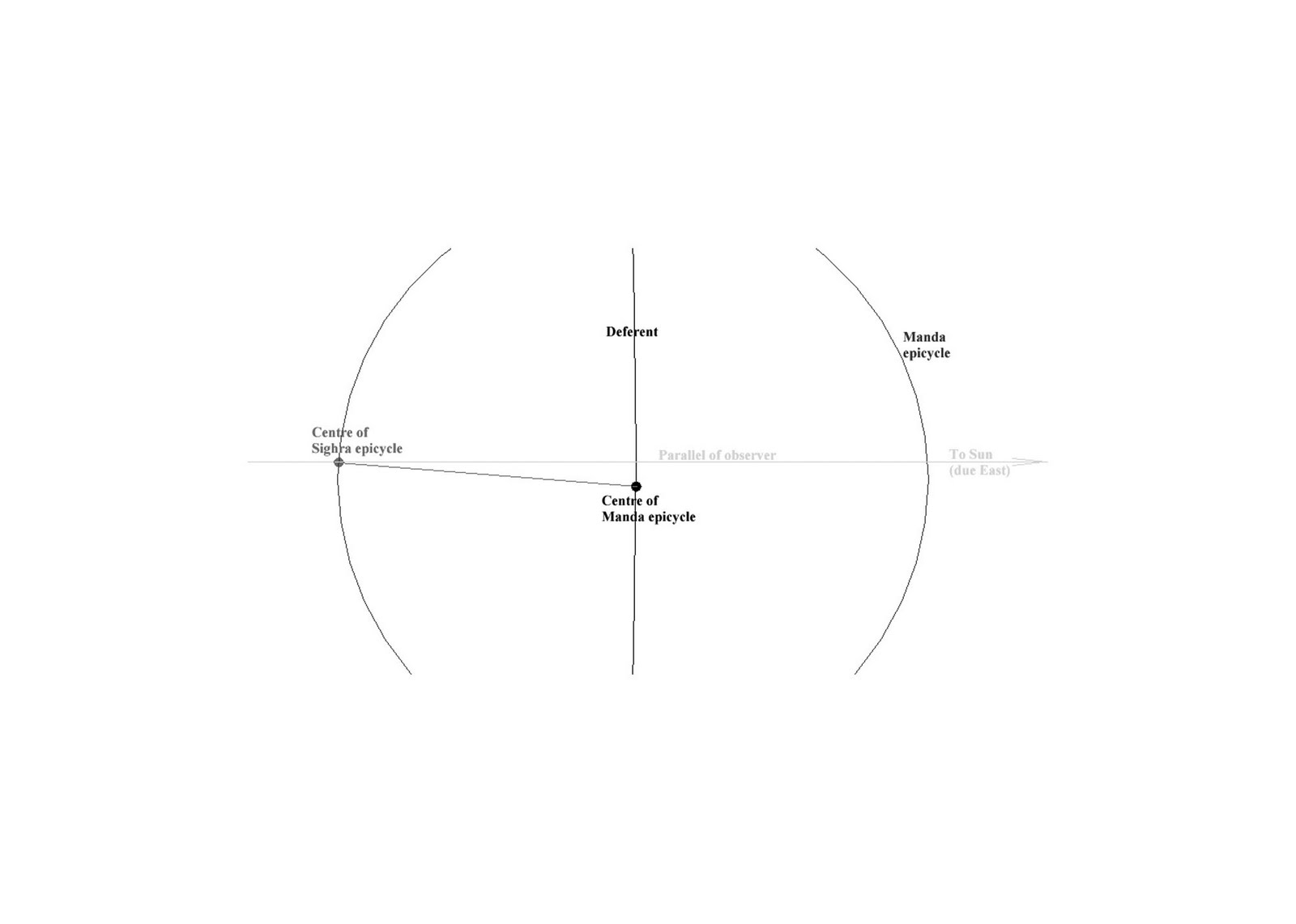
We have the Double Epicyclic Model – that of Manda Epicycle and Sheegra Epicycles – in Indian Astronomy, which explain the Zodiacal and Solar anomalies. One Epicycle explains the Zodiacal Anomaly and the other the Solar Anomaly.
( Zodiacal Anomaly – That all planets move slower at Aphelion and faster at Perihelion. Solar Anomaly – The astronomical phenomenon of Retrogression. Backward Motion. When a planet changes its course from perihelion to aphelion, it retrogrades in order to gain the Sun’s celestial gravity )
Dennis Duke, of Florida State University, says ” We have only to conclude that Ptolemy did not invent the equant. ” If Ptolemy did not invent the equant, as Westerners widely believe, then who did ?
“The bisected Indian equant model is pre-Ptolemaic’ says he. Other Greek books, prior to Ptoemy, may have influenced Indian Astronomy,says he. Then what are those books, prior to the Almagest, which had influenced the Indian system? The answer is “unknown sources”.
Remarks Duke ” Indeed, since the very earliest investigation of the Indian models by Western scholars it has been presumed that the models are somehow related to a double epicycle system, with one epicycle accounting for the zodiacal anomaly, and the other accounting for the solar anomaly (retrograde motion) This perception was no doubt reinforced by the tendency of some Indian texts to associate the manda and sighra corrections with an even older Indian tradition of some sort of forceful cords of air tugging at the planet and causing it to move along a concentric deferent . Since our goal in this paper is to investigate the nature of any connection with ancient Greek planetary models, it is only important to accept that the models appear in Indian texts that clearly pre-date any possible Islamic influences, which could, at least in principle, have introduced astronomical elements that Islamic astronomers might have derived from Greek sources. ( “The Equant in India: the Mathematical Basis of Ancient Indian Planetary Models” By Dennis Duke, Florida State University )
We have the Double Epicyclic Model – that of Manda Epicycle and Sheegra Epicycles – in Indian Astronomy, which explain the Zodiacal and Solar anomalies. One Epicycle explains the Zodiacal Anomaly and the other the Solar Anomaly.
( Zodiacal Anomaly – That all planets move slower at Aphelion and faster at Perihelion. Solar Anomaly – The astronomical phenomenon of Retrogression. Backward Motion. When a planet changes its course from perihelion to aphelion, it retrogrades in order to gain the Sun’s celestial gravity )
Dennis Duke, of Florida State University, says ” We have only to conclude that Ptolemy did not invent the equant. ” If Ptolemy did not invent the equant, as Westerners widely believe, then who did ?
“The bisected Indian equant model is pre-Ptolemaic’ says he. Other Greek books, prior to Ptoemy, may have influenced Indian Astronomy,says he. Then what are those books, prior to the Almagest, which had influenced the Indian system? The answer is “unknown sources”.
Remarks Duke ” Indeed, since the very earliest investigation of the Indian models by Western scholars it has been presumed that the models are somehow related to a double epicycle system, with one epicycle accounting for the zodiacal anomaly, and the other accounting for the solar anomaly (retrograde motion) This perception was no doubt reinforced by the tendency of some Indian texts to associate the manda and sighra corrections with an even older Indian tradition of some sort of forceful cords of air tugging at the planet and causing it to move along a concentric deferent . Since our goal in this paper is to investigate the nature of any connection with ancient Greek planetary models, it is only important to accept that the models appear in Indian texts that clearly pre-date any possible Islamic influences, which could, at least in principle, have introduced astronomical elements that Islamic astronomers might have derived from Greek sources. ( “The Equant in India: the Mathematical Basis of Ancient Indian Planetary Models” By Dennis Duke, Florida State University )
We have the Double Epicyclic Model – that of Manda Epicycle and Sheegra Epicycles – in Indian Astronomy, which explain the Zodiacal and Solar anomalies. One Epicycle explains the Zodiacal Anomaly and the other the Solar Anomaly.
( Zodiacal Anomaly – That all planets move slower at Aphelion and faster at Perihelion. Solar Anomaly – The astronomical phenomenon of Retrogression. Backward Motion. When a planet changes its course from perihelion to aphelion, it retrogrades in order to gain the Sun’s celestial gravity )
Dennis Duke, of Florida State University, says ” We have only to conclude that Ptolemy did not invent the equant. ” If Ptolemy did not invent the equant, as Westerners widely believe, then who did ?
“The bisected Indian equant model is pre-Ptolemaic’ says he. Other Greek books, prior to Ptoemy, may have influenced Indian Astronomy,says he. Then what are those books, prior to the Almagest, which had influenced the Indian system? The answer is “unknown sources”.
Remarks Duke ” Indeed, since the very earliest investigation of the Indian models by Western scholars it has been presumed that the models are somehow related to a double epicycle system, with one epicycle accounting for the zodiacal anomaly, and the other accounting for the solar anomaly (retrograde motion) This perception was no doubt reinforced by the tendency of some Indian texts to associate the manda and sighra corrections with an even older Indian tradition of some sort of forceful cords of air tugging at the planet and causing it to move along a concentric deferent . Since our goal in this paper is to investigate the nature of any connection with ancient Greek planetary models, it is only important to accept that the models appear in Indian texts that clearly pre-date any possible Islamic influences, which could, at least in principle, have introduced astronomical elements that Islamic astronomers might have derived from Greek sources. ( “The Equant in India: the Mathematical Basis of Ancient Indian Planetary Models” By Dennis Duke, Florida State University )
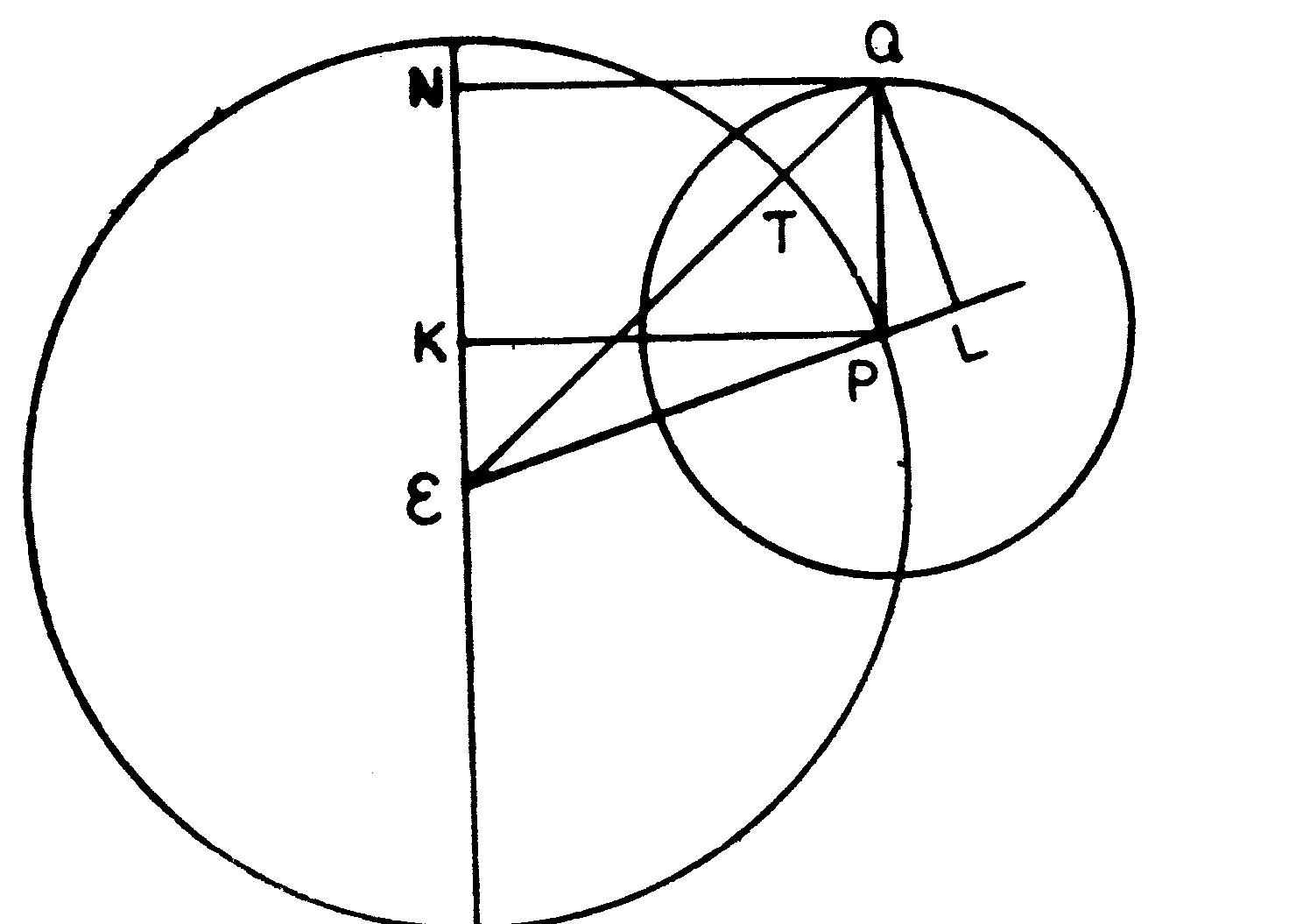
In the diagram above, the geocentric distance, EQ called X here , the distance of the planet from the Earth is calculated by the equation
X^2 = EQ^2(EP+PL)^2 + QL^2
or = EN^2 + QN^2
In a trignometric correction, called Sheegra Sphashteenarana, this equation is given by Bhaskara.
where
E = Earth P = Planet in its Orbit Q = Planet on the Epicycle QL = Sin PL = Cos
We have said that Sheegra Kriya reduces the heliocentric postions to the geocentric.
According to this oscillating Epicyclic Model of Bhaskara, EP = R ( Called Thrijya ), PQ is the Sheegra Phala, QL is the Bhujaphala and PL is Kotiphala.
The Hindu algorithms for the computation of mean and true celestial longitudes seems to be totally different from the Western, from the methods adopted by Kepler, Laplace and Co. Hence the Hindu Planetary Model is original and not influenced by Greco Roman sources, as some Western scholars believe.
In the diagram above, the geocentric distance, EQ called X here , the distance of the planet from the Earth is calculated by the equation
X^2 = EQ^2(EP+PL)^2 + QL^2
or = EN^2 + QN^2
In a trignometric correction, called Sheegra Sphashteekarana, this equation is given by Bhaskara.
where
E = Earth P = Planet in its Orbit Q = Planet on the Epicycle QL = Sin PL = Cos
We have said that Sheegra Kriya reduces the heliocentric postions to the geocentric.
According to this oscillating Epicyclic Model of Bhaskara, EP = R ( Called Thrijya ), PQ is the Sheegra Phala, QL is the Bhujaphala and PL is Kotiphala.
The Hindu algorithms for the computation of mean and true celestial longitudes seems to be totally different from the Western, from the methods adopted by Kepler, Laplace and Co. Hence the Hindu Planetary Model is original and not influenced by Greco Roman sources, as some Western scholars believe.
In the diagram above, the geocentric distance, EQ called X here , the distance of the planet from the Earth is calculated by the equation
X^2 = EQ^2(EP+PL)^2 + QL^2
or = EN^2 + QN^2
In a trignometric correction, called Sheegra Sphashteekarana, this equation is given by Bhaskara.
where
E = Earth P = Planet in its Orbit Q = Planet on the Epicycle QL = Sin PL = Cos
We have said that Sheegra Kriya reduces the heliocentric postions to the geocentric.
According to this oscillating Epicyclic Model of Bhaskara, EP = R ( Called Thrijya ), PQ is the Sheegra Phala, QL is the Bhujaphala and PL is Kotiphala.
The Hindu algorithms for the computation of mean and true celestial longitudes seems to be totally different from the Western, from the methods adopted by Kepler, Laplace and Co. Hence the Hindu Planetary Model is original and not influenced by Greco Roman sources, as some Western scholars believe.
Different equations have been given for superior planets ( Mars, Jupiter and Saturn ) and inferior planets ( Mercury and Venus ) in Astronomia Indica.
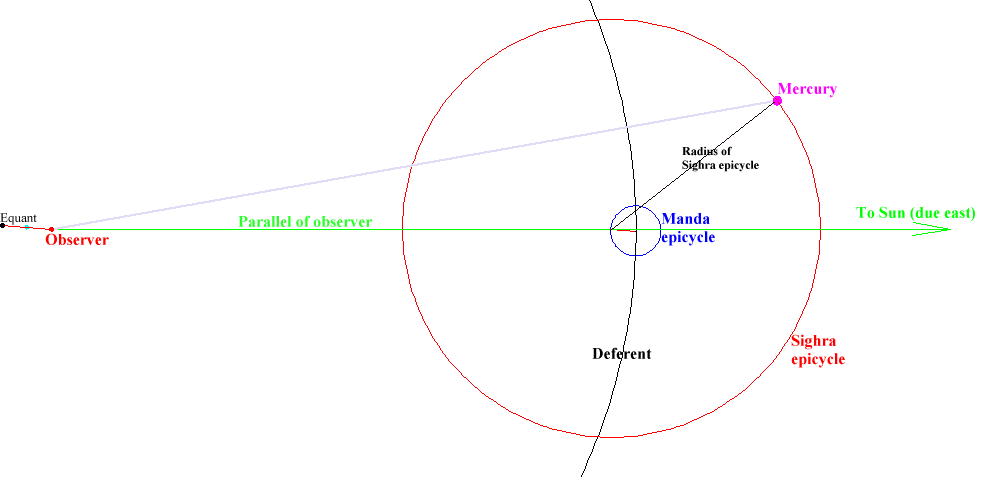
In the case of Mercury, an inferior planet in the diagram above, the center of the Sheegra Epicycle is located on the straight line running through the Sun and the observer, on the geographical parallel of the observer.
The Sheegra Phalam, x, in the equation 1/2 Tan ( A -x ), where A is the Elongation or Sheegra Kendra, obtained is deducted from the Sun’s longitude, to get the geocentric longitudes of Mercury and Venus.