As the seven planets correspond to the days of the week,

Jupiter  	Thursday
Sun  	        Sunday
Moon  	        Monday
Mars  	        Tuesday
Mercury  	Wednesday
Venus  	        Friday
Saturn  	Saturday

the day of week which corresponds to the afflicted planet is given prime importance and fasting and other remedial measures are prescribed for that day. This is the rationale of Vara Puja.

Sun's day is Sunday and Moon's day is Monday. ( From the Latin Dies Luna and the Sanskrit Soma Var . Dies Sol and Ravi Var) . Mars is known as Tiv in Norse Mythology and hence Tiv's day became Tuesday ( From the Sanskrit Mangal Var and the Latin Dies Marti ). Woten is Mercury and Woten's day became Wednesday. ( From the Latin Dies Mercuri and the Sanskrit, Budha Var ).

Thor is Jupiter in Norse Mythology and hence Thor's day became Thursday ( Sankrit Brihaspati Var and the Latin Iovis Dies ) . Freya is Venus and Freya's day became Friday ( Latin Dies Freya and Sanskrit Shukra Var ). Saturn's day is Saturday. ( Dies Saturni and Shani Var ).

The day of week which corresponds to the afflicted planet is given prime importance and fasting and other remedial measures are prescribed for that day. This is the rationale of Vara Puja.

Vareshan Kalpayithvadvou
Jyothis Chakra Prathishtithan
Swaswa Vare Thu Theshaam Thu
Swa Swa Pooja Phala prada


VARA PUJA for the Nine Revolving Heavens

The Law of Correspondences

Each planet has a corresponding Day, a corresponding Gemstone, a corresponding Deity, a corresponding Yantra, a corresponding Mantra & a corresponding Holy Book.

Vara Puja is said to be the most effective remedy in Vedic Astrology. On the day of the problem causing planet that planet is to be propitiated. If Jupiter is the problem causer, Thursday is the day where the Deity of Jupiter ( Lord Vishnu ), the Yantra of Jupiter ( Brihaspathi  Yantra ), the mantra of Jupiter ( Om Brihaspatayai Namah), the Holy Book of Jupiter ( Geetha) & the gemstone of Jupiter ( Yellow Sapphire ) should be propitiated. Similarly for all other planets.

Every Deity has a mantra. For instance Maha Mrityunjaya Mantra has been found to be very effective while dealing with afflictions caused by Saturn. The Planet and the Deity are both Thamasic by nature.
Sun
Sunday
Ruby
Suryaya Namah
Soorya
Aditya Hridayam
Lord Siva
Moon
Monday
Pearl
Soma
Devi Mahatmyam
Durga
Jupiter
Thursday
YellowSapphire
Brihaspataye Namah
Brihaspati
Geetha
Vishnu
Mars
Tuesday
Coral
Angarakaya Namah
Kuja
Devi Mahatmyam
Muruga
Venus
Friday
Diamond
Shukraya Namah
Shukra
Soundaryalahari
Lakshmi
Saturn
Saturday
Blue Sapphire
SanischarayaNamah
Shaneeswara
Devi Mahatmyam
Ayyappa
Mercury
Wednesday
Emerald
Budhaya Namah
Budha
Geetha
Vishnu
Rahu
Saturday
Hessonite
Rahave Namah
Rahu Yantra
Devi Mahatmyam
Ayyappa
Ketu
Tuesday
Cat's Eye
Ketave Namah
Ketu Yantra
Devi Mahatmyam
Durga

Sun 	Sunday   	Ruby         	Suryaya Namah 	Soorya	Aditya Hridayam	Lord Siva
Moon 	Monday	Pearl 	Somaya Namah 	Soma	Devi Mahatmyam 	Durga
Jupiter 	Thursday 	YellowSapphire	Brihaspataye Namah	Brihaspati	Geetha 	Vishnu
Mars 	Tuesday	Coral 	Angarakaya Namah	Kuja 	Devi Mahatmyam	Muruga
Venus  	Friday 	Diamond 	Shukraya Namah 	Shukra 	Soundaryalahari 	Lakshmi
Saturn	Saturday	Blue Sapphire 	SanischarayaNamah	Shaneeswara	Devi Mahatmyam 	Ayyappa
Mercury 	Wednesday	Emerald 	Budhaya Namah 	Budha 	Geetha 	Vishnu
Rahu	Saturday	Hessonite	Rahave Namah 	Rahu Yantra 	Devi Mahatmyam 	Ayyappa
Ketu	Tuesday 	Cat's Eye 	Ketave Namah 	Ketu Yantra	Devi Mahatmyam 	DurgaPlanet       Day                 Gem                          Mantra                              Yantra                    Book                               Deity
Sun  	Sunday    	Ruby          	Suryaya Namah  	Soorya 	Aditya Hridayam 	Lord Siva
Moon  	Monday 	Pearl  	Somaya Namah  	Soma 	Devi Mahatmyam  	Durga
Jupiter  	Thursday  	YellowSapphire 	Brihaspataye Namah 	Brihaspati 	Geetha  	Vishnu
Mars  	Tuesday 	Coral  	Angarakaya Namah 	Kuja  	Devi Mahatmyam 	Muruga
Venus   	Friday  	Diamond  	Shukraya Namah  	Shukra  	Soundaryalahari  	Lakshmi
Saturn 	Saturday 	Blue Sapphire  	SanischarayaNamah 	Shaneeswara 	Devi Mahatmyam  	Ayyappa
Mercury  	Wednesday 	Emerald  	Budhaya Namah  	Budha  	Geetha  	Vishnu
Rahu 	Saturday 	Hessonite 	Rahave Namah  	Rahu Yantra  	Devi Mahatmyam  	Ayyappa
Ketu 	Tuesday  	Cat's Eye  	Ketave Namah  	Ketu Yantra 	Devi Mahatmyam  	Durga


Monday Vara Puja

Normally women are the people who observe this Vara Puja. Also those who suffer from a malefic Moon Dasa.

In order to get a good spouse, longevity of marriage, longevity of husband, children , prosperity for family- all these are the objectives of Monday Vara Puja.

Durga is the presiding Deity of the Moon, Durga Chandrasya Devatha. As the Symbol of the Self is the Sun, so the Symbol of the Mind is Moon, Mano Matharo Sheetha Rashmi. Durga means the Surmounter of difficulties, the difficulties of Samsar, the ocean of worldliness.

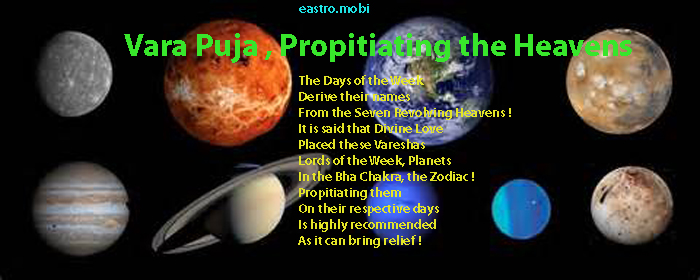
The Days of the Week
Derive their names
From the Seven Revolving Heavens !
It is said that Divine Love

Placed these Vareshas
Lords of the Week, Planets
In the Bha Chakra, the Zodiac !

Propitiating them
On their respective days
Is highly recommended
As it can bring relief !

Tuesday Vara Puja

This is observed to get the Grace of the Mother Divine and Hanuman. Those who have Martian affliction in their horoscopes also observe this Vara Puja. They go to Darshan of the temples of Goddess, Muruga and Hanuman. Rice and salt are avoided in supper.

Tuesday derives from the Norse Tiv's day. The Indian equivalent is Lord Subrahmanya, the Celestial Military Commander. The word Martial is derived from Mars. Administrative skill can only be there if a beneficent Mars is placed well in a horoscope. Those with Mars weak should get the Grace of Mars, of  Lord Muruga, Hanuman et al.

Wednesday  Vara Puja

This is observed by people who are suffering from Mercurian affliction, that is, from a badly placed Mercury in their horoscope. Darshan in the Temples of the Nine Planets, in the temples consecrated to Lord Vishnu.  Light food at supper.

Woten's Day became Wednesday. In the East Budhavar is consecrated to Budha or Mercury. Mercurian affliction manifests as breaks in education, as poor knowledge, poor mathematical ability etc. Those who have weak Mercury in their charts should propitiate Mercury and Lord Vishnu's Avatars.

Thursday Vara Puja

This is observed by people who are afflicted by badly placed Jupiter or the affliction by Transit Jupiter. This is to please Lord Vishnu, whose Avatar represents Jupiter, Saumyotha Vishnur Guru. Early morning bath and Darshan in Temples dedicated to the Nine Revolving Heavens can bring home the result.

Thor's Day became Thursday. The Supreme Indian Deity, Lord Vishnu, represents the Father of the Heavens, Dyo Pithah or Jupiter. Those who have weak Jupiter in their horoscopes should please the Jupiter so that the Jupiterian Energy manifests in them. This Energy manifests as Genius, Poetry, Intuition, Inspiration et al.

Friday Vara Puja

This is to please Goddess Anna Poorneswari. Lakshmi will grace the native. Those who undergo Venus Dasa normally do this Vara Puja. Observance of this is good for prosperity.

Venus in three decanates represents different Deities. In a Sattwic decanate, She is Anna Poorneswari. In a Rajasic decanate, She is Lakshmi. In a Thamasic decanate, She is Durga ( Anna Poorneswaree Lakshmee Yakshee va Bhrigu Nandana ).

Whether a decanate is Sattwic, Rajasic or Thamasic can be discerned by studying the decanate. If the decanate is ruled by Jupiter and Moon, the decanate is Satwic. If by Venus or Mercury, Rajasic.  And if by Mars and Saturn, Thamasic.

Saturday Vara Puja

This is to please Lord Saturn. Those who suffer from Elarata Saturn and Angular Saturn ( Kandaka Sani ) normally do this. Have a bath early morning and go and see Lord Ayyappa, who is the Deity of Saturn, Manda Saasthadi Daivam. Do Neeranjanam. In temples dedicated to the Nine Planets, ellunthiri can be given to Lord Ayyappa.

Saturn's Day is Saturday. Those who have a weak Saturn in their horosocpe should augment the Saturnine Energy. This Energy manifests as industriousness, shrewd cunning ( which is needed in Economics and Politics ) and knowledge of Psychology. Ayyappa, the son of Vishnu ( Sattwas ) and Shiva ( Thamas ) is the ideal Deity and He can imbue one with Saturnine Energy !

Sunday Vara Puja

Those who suffer from a badly afflicted Sun do this Puja. Also for the destruction of all sins. One should fast on Sunday  and go to Darshan in Temples dedicated to the Nine Planets or Shiva, as the Deity of the Sun is Lord Shiva, Arka Shambu.

Propitiate Sun. Chant Gayatri, Soorya Gayatri etc. One meal should be avoided on Sundays. Aditya Hridayam can be recited.
After his divine experience,
Wherein he saw the Divine in all,
Aurobindo postulated an amazing theory,
The Sevenfold Chord of Being.

Dialectical Integralism is his system,
As He integrated both Purusha and Prakriti
Integrating Idealism and Materialism Dialectical,
Both Hegel and Marx, is never easy.

He stood for Sacred Balance
Of powerful Matter and Spirit Blissful
"Spirit shall see through Matter's gaze,
Matter shall reveal the Spirit's Face"

The lower Trilogy of Life , Mind and Matter
Constitute Relative Being.
The higher Trinity of Being, Knowledge and Bliss
Constitute Absolute Being.

Which is that seventh element,
Which binds the Absolute and Relative?
It is called Supermind, a state,
Beyond Overmind and Mind.

This is Sevenfold mode of Existence Cosmic,
Seven Names of the Nameless,
Seven Rays of Infinity
And Seven Colors of Consciousness !

Supermind, then, is the Alpha and the Omega,
The instrument of all unification,
Originative, executive and consummative,
In all realisable harmonies.

Evolution of this Sevenfold Being,
Realisation of Its Septuple Name,
Was considered divine destiny,
Of all, which cometh from One.

The Divine descending into materiality,
Is called humanity.
With Matter as the lowest term,
And pure Being as the highest.

The lower Trilogy of Life, Mind and Matter,
Are merely the subordinate action powers,
Of the Divine Quaternary,
Being, Knowledge, Bliss & Supermind.
Brahman
Verily, Brahman is All in All.

Yatho imani bhutani jayante
Yena jatani jivanti
Yat prayantyabhisam visanti