

SearchGet app
Sign up

Trigonometry: The Jya and Cojya in Indian Mathematics, Computation of R-Sines, and Madhava’s Sine and Cosine Series
MAITRI DESAIFollow
6 min read
·
Oct 13, 2025
Mathematics, as we know it today, is a tapestry woven from the intellect of civilizations across time. Among them, ancient India stands out for its profound and systematic contributions to trigonometry – a field that connects geometry and the measurement of the heavens. Long before modern symbols like sin θ and cos θ appeared, Indian mathematicians had already developed the conceptual and computational foundations of trigonometric functions, using terms like Jya (or Jiva) and Cojya (or Kojiva).
This blog explores how these early Indian ideas evolved into the trigonometry we study today, the computation of R-sines, and the remarkable Madhava series, which foreshadowed modern calculus centuries before its formal birth in Europe.
The Origins: Trigonometry in Indian Astronomy
The earliest form of trigonometry in India arose from the needs of astronomy. Tracking the movements of celestial bodies required precise measurements of angles and arcs. Unlike the Greeks, who used the chord of an angle (a straight line connecting two points on a circle), Indian astronomers used half-chords – which we now call the sine.
This shift was revolutionary. The chord system of the Greeks, found in works like Ptolemy’s Almagest, measured the entire line spanning an arc. But Indian mathematicians realized that the half-chord simplified calculations and geometric reasoning. They called it Jya (or Jiva), derived from Sanskrit, meaning “bowstring.”
Thus, the Jya of an arc was defined as the length of the half-chord subtending that arc at the center of a circle.
To complement this, Indian scholars introduced the Cojya (Kojiva), meaning “the complement of the Jya.” It represented what we now know as the cosine function. The concept of complementary angles was well understood, and so:
Cojya(θ) = Jya(90° − θ)
In modern notation,
sin(θ) = Jya(θ)
cos(θ) = Cojya(θ)
These definitions formed the backbone of Indian trigonometry.
From Jya to Sine: A Journey of Words
The transformation from Jya to Sine is itself a fascinating linguistic journey that mirrors the transmission of mathematical knowledge across cultures.
When Indian astronomical texts such as the Siddhānta works were translated into Arabic around the 8th – 9th centuries CE, Jiva (or Jya) was transliterated as jiba. However, since Arabic script often omitted vowels, later translators read jiba as jaib, meaning “fold” or “bay” in Arabic.
When these Arabic works reached medieval Europe through Latin translations, jaib was rendered as sinus, which also means “fold” or “curve” in Latin. Hence, the English term “sine” was born – a direct descendant of India’s Jya.
Similarly, Cojya transformed into cosine, as it was recognized as the sine of the complementary angle. Thus, every time we write sin or cos, we echo the mathematical wisdom of ancient India.
The Computation of R-Sines
A critical step in ancient Indian trigonometry was the computation of sine tables, often called R-sines (or “radius-based sines”). Here, the “R” stood for the radius of the circle – typically taken as 3438 in Indian astronomy. This number wasn’t arbitrary: it was derived from dividing the circle’s circumference (≈ 2π × 3438 ≈ 21,600 minutes of arc), allowing convenient calculation of sine values for every degree or minute.
Aryabhata’s Table of Sines
The first known sine table in India appears in Aryabhata’s Aryabhatiya (circa 499 CE). Aryabhata tabulated sine values for every 3¾° interval, using the radius of 3438. His table gave the R-sine values in a sequence of integers – an early trigonometric table centuries before similar developments in Europe.
Aryabhata also devised an ingenious recursive method to compute these values. He used the first difference between successive sines to compute the next, effectively anticipating the idea of finite differences used in modern numerical methods.
This method was expressed in verse form (as was the custom in ancient India) and reveals the blend of poetry and precision that characterized early Indian mathematical writing.
Bhaskara I and Refinement of Computations
Get MAITRI DESAI’s stories in your inbox
Join Medium for free to get updates from this writer.Subscribe
Remember me for faster sign in
Following Aryabhata, Bhaskara I (7th century CE) provided clearer explanations and computational techniques for sine and cosine values. His work included a remarkable approximation formula for sine:
sin(θ) ≈ (16θ(π − θ)) / (5π² − 4θ(π − θ))
This formula gives impressively accurate results for small angles and demonstrates a deep intuitive understanding of the sine function’s behavior.
Bhaskara’s innovations also influenced later mathematicians of the Kerala School, which became the pinnacle of trigonometric and infinite series studies in pre-modern India.
Madhava of Sangamagrama and the Kerala School
Fast forward to the 14th century CE, in the lush region of Kerala in South India. Here, a new mathematical revolution unfolded, led by Madhava of Sangamagrama (circa 1340 – 1425 CE). Madhava’s genius lay in extending trigonometry beyond geometric constructs into infinite series, paving the way for the calculus of the future.
Madhava and his successors – such as Parameshvara, Nilakantha Somayaji, and Jyesthadeva – formed what is now called the Kerala School of Mathematics and Astronomy. Their contributions to trigonometric series expansions predated similar discoveries in Europe by almost three centuries.
Madhava’s Sine and Cosine Series
Madhava’s insight was to express trigonometric functions as infinite power series – a concept that lies at the heart of modern analysis. He recognized that the sine and cosine of an angle could be represented as sums of infinite terms involving powers of the angle.
In modern notation, Madhava’s series can be written as:
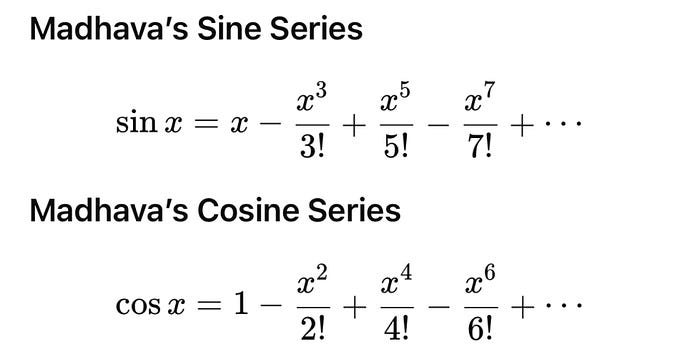
These are precisely the series expansions found in modern calculus textbooks – derived in Europe by Newton and Leibniz in the 17th century, but already known in Kerala by the 14th.
What’s more, Madhava provided error terms and correction formulas to improve the accuracy of these approximations – demonstrating not only discovery but deep analytical understanding.
The Path to π: Madhava’s Series for Arctangent
Madhava didn’t stop with sine and cosine. He also derived the series for arctangent, which became famous later as the Gregory – Leibniz series for π:
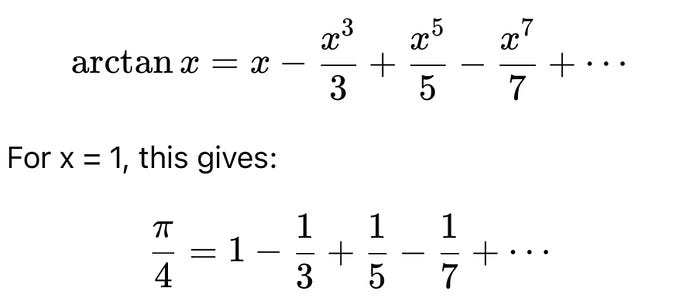
Madhava used this formula to compute π to an astonishing 11 decimal places, using manual calculations and rational corrections. This was perhaps the most accurate known value of π in the world at the time.
The Legacy of Indian Trigonometry
From Aryabhata’s half-chords to Madhava’s infinite series, Indian mathematicians laid down the intellectual foundations for trigonometric and analytical thinking. Their works show a seamless blend of geometry, algebra, and analysis, centuries before these fields were formally separated.
The Jya and Cojya concepts evolved into the sine and cosine, while the computation of R-sines provided the earliest trigonometric tables. Madhava’s expansions transformed these geometric ideas into algebraic series – a conceptual leap that foreshadowed the calculus revolution of the modern era.
Conclusion: Rediscovering the Roots
Trigonometry, as we study it today, is deeply indebted to the mathematical heritage of India. The Jya and Cojya were not merely tools for astronomy; they were the first steps toward understanding periodicity, circular motion, and the continuous nature of change.
The story of Indian trigonometry reminds us that knowledge is a collective human journey. When we write equations like

we are, knowingly or not, echoing the genius of Madhava of Sangamagrama, Aryabhata, and Bhaskara – the mathematical visionaries who looked to the skies and discovered the secrets of the circle.
Written by MAITRI DESAI
·1 followingFollow
5 Minute History’s post
5 Minute History
How Indian Hindu Numeral System became “Arabic”
The Hindu numeral system along with zero was developed in India by around 700 AD. This system was the refined form of earlier Indian Brahmi system that predate the common era. The first Brahmi numerals, were used by Ashoka in his Edicts in 250 BC.
The decisive step in the gradual development of hindu numerals that spanned several centuries, was probably provided by Brahmagupta’s formulation of zero as a number in 628 AD. Prior to Brahmagupta, zero was in use in various forms but was regarded as a ‘blank spot’ (Shunya Sthana) in a positional number. It was only used by mathematicians (ganakas—people doing calculations) while the general populace used the traditional Brahmi numerals.
After 700 AD, the decimal numbers with zero replaced the Brahmi numerals. The system was revolutionary by limiting the number of individual digits to ten. It is considered an important milestone in the development of mathematics.
The Hindu numeral system soon became very popular. It was introduced to Arab court of Baghdad in 9th century AD. Arab mathematician and scholar Al khwarizmi wrote a book “On the Calculation with Hindu Numerals (Arabic: الجمع والتفريق بحساب الهندي)’ in 825 AD. This was followed by Al-Kindi, who wrote four volumes, “On the Use of the Indian Numerals (Ketab fi Isti’mal al-‘Adad al-Hindi)” in 830 AD. Later Persian scientist Kushyar Gilani wrote “Kitab fi usul hisab al-hind (Principles of Hindu Reckoning)”. It is one of the oldest surviving manuscripts using the Hindu numerals. These works were principally responsible for the diffusion of the Indian system of numeration in the Arab world and the Middle East.
In the 10th century, Middle-Eastern mathematicians extended the Hindu decimal numeral system to include fractions, as recorded in a treatise by Syrian mathematician Abu’l-Hasan al-Uqlidisi in 952–953 AD. According to Al-Beruni, there were multiple forms of numerals in use in India, and “Arabs chose among them what appeared to them most useful”.
Al-Nasawi wrote in the early eleventh century that the mathematicians had not agreed on the form of numerals, but most of them had agreed to train themselves with the forms now known as Eastern Arabic numerals.
Soon this new system of numerals was introduced in Christian Europe by Arabic-speakers of North Africa, who were then using the digits from Libya to Morocco. As such this system came to be known as “Arabic” by Europeans. In Christian Europe, the first mention and representation of Hindu–Arabic numerals (from one to nine, without zero), is in the Codex Vigilanus, an illuminated compilation of various historical documents from the Visigothic period in Spain, written in the year 976 by three monks of the Riojan monastery of San Martín de Albelda.
Leonardo Fibonacci in his book “Liber Abaci” (1202) introduced Indian numerals, the use of zero, and the decimal place system to the Latin world. It was used in European mathematics from the 12th century, and entered common use from the 15th century to replace Roman numerals.
All reactions:
43
Björn He Bergman
It seems that the digit 0 (zero) originally was used to represent the number ten, but later, 0 became a number for something non-existing, and the number ten was from then written “10” rather than only “0”, twenty was written “20” = “two tens”, and so on.
- 3w
Jai SANATANI lipi.
Jai SANATANI HINDU DHARM. 
- 45w