

Astrolgy is Astronomy brought down to earth, to participate in the affairs both mundane and supramundane – of men !
Knowledge – both wordly and divine -is the prerogative of Jupite,r, Jnanani Vagveeswarath ! He represents Happiness, learning and Wisdom., Deveyo Jnana Sukhado. He may not give Wealth sometimes. but he will give Divine Wealth, Vidya Dhanam, intellectuall Wealth, conducuve to Self Actualisation. It is said that the the Emperor envied the Miller ( as the Emperor was unhappy despite his wealth and the Miller, despite his poverty, was happy), so Jupiter gives Spreme Happiness and Eternal LIberation !
Jupiter is the greatest benefic,
In the Astrological hierarchy
He is so voluminous that,
1300 earths can be fit into him.
The ancient Eternians,
Called him Dyo Pitah,
DYo means Heavens, Pitha is father,
The Father of the Heavens !
Marlowe called him the Monarch of the sky,
Lord and Commander of Elements,
HE IS THE King Maker,
He is powerful in charts of Rulers !
If he retrogrades,
Will confer royal power,
In the horoscope of Indira Gandhiji,
He is Vakra Vargottama !
He is angular,
In charts of British Sovereigns,
He is either rising,
Or culminating, in 1 or 10.
Jove is derived from Jyok,
Jeeve Angirah Vachaspati Jyok,
The phrase By Jove is derived from him,
From mighty Astrology.
The genius of Varaha MIhira,
In his treatise Brihat Hora Sastra,
Summed up the Effects of Jove Natal,
In four simple lines of poem.
Vidwan Suvakya Kripana Sukhee cha
Dheeman Asatru Pitrukodhikascha
Neechas tapaswi sadhana sa labha,
Khalascha Jeeve Kramaso Vilagnath.
In the First, a Scholar extraordinaire,
In the Second, with the gift of the gab,
In the Third, money loving, miserly,
In the Fourth an enjoyer of sense.
In the FIfth, a great intellect,
In the Sixth, devoid of enemies.
In he Seventh, surpasses father,
In the Eighth, immoral & wealthy.
In the 9th, a divine,
In the 10th, with Wealth,
In the 11th, with great gains,
And in the 12th, wicked man !
MORE AT EASTROVEDICAHTTPS://WWW,RASTROVEDICA.COM
The genius of Varaha Mihira summed up all significations of the Houses Twelve into just 2 lines ! Kalya Sva Vikrama Griha Pratibha Kshatani / Chittotta Randra Guru Mana Bhava Vyayani ! Kalya -Body- First House; Swa – Wealth, 2 H, Vikrama – Valor – 3 H; Griha – Home – 4 H, Pratibha – Inteligence – 5H; Kshatani – Enemies – 6 H; Chitta – Mind – 7 H; Randhra – Death – 8 H; Guru – Divinity – 9 H; Mana – Profession – 10 H; Bhava –Income – 11 H & Vyaya – Expenditure – 12 H !
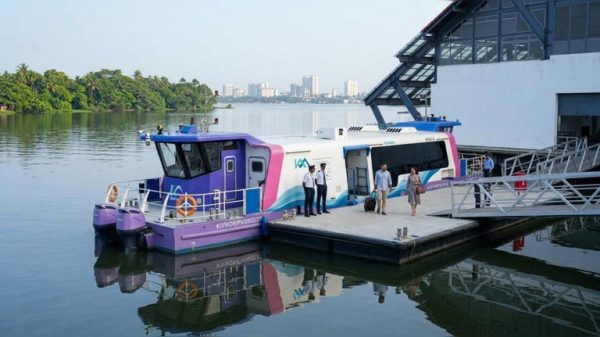
Kochi Water Metro Limited (KWML) is set to enhance its fleet with the upcoming procurement of 15 electric boats, aimed at improving service frequency on the highly frequented High Court–Fort Kochi and Vyttila–Kakkanad routes. These new vessels will not only serve Fort Kochi and Kakkanad but will also establish connections to the mainland areas of Edakochi, Kadamakudy, Kumbalam, and Thevara.
SBI Life Insurance·Sponsored


Sajan P. John, the Chief Operating Officer of KWML, expressed optimism about the new electric ferries, stating, “The induction of new vessels would help connect more islands with mainland Kochi. We decided to opt for electric ferries after gaining confidence from operating the electric-hybrid ones for over three years.” Currently, KWML operates a fleet of 20 electric-hybrid ferries in the Greater Kochi area. With the addition of the new boats, the total number of Water Metro ferries will increase to 38, including three more from the initial batch expected to join soon.
Improved Service Frequency
The pre-bid meetings for the tender have concluded, with qualified firms set to submit their bids by Monday, August 10. Each of the new electric ferries is designed to accommodate up to 100 passengers. Mr. John highlighted that the introduction of these additional ferries will allow KWML to operate a ferry every 10 minutes during peak hours on the Fort Kochi and Kakkanad routes, a significant improvement from the current schedule of one ferry every 15 to 20 minutes. To support this increased frequency, KWML plans to install more floating pontoons at the Vyttila and High Court terminals, as well as at the South Chittoor ferry terminal.
Atlassian Jira™·Sponsored
Design Enhancements
The new ferries will feature outboard motors, which can be lifted to facilitate the removal of floating debris, such as ropes that may become entangled. This design change addresses a significant operational challenge faced by the first batch of ferries, which were equipped with inboard motors that required workers to dive beneath the vessels to clear debris—a process that was both time-consuming and labor-intensive. While the overall design will remain similar, these enhancements are expected to streamline operations significantly.
The Kochi Water Metro project aims to extend the metro rail experience to waterways, providing reliable and safe transportation for approximately 100,000 island residents, thereby enhancing connectivity in the region.
What is an Arohinee Planet ? Arohanam and Avarohanam means Ascension and Descension. A planet moving away from his deep Debilitation Point is Arohinee, Arohinee nimna parichyutasya Neechari Bhageth Adhama Bhaveth sa. Such a planet’s reign is denoted as Atheeva Dosha phalada, adverse !
What is an Avarohee planet ? A planet moving from his sign of exaltation is called Avarohee, Bhrishtasya Thungath Avarohee Samjna.
After assessing the strengths of planets by Shad Bala, we should see their Samjnas. An exalted planet without other strengths like directional, temporal, motional et al is called Rikta, Samyka Balina Swa Tunga Bhage / Sampoorna Balavarjitasya Rikta ! Whereas the exalted planet with directional or other strengths is Sampoorna !
Invest in India, in food processing !
Indian Food Processing: An Untapped Growth Opportunity

By: Aayushi Bhatia

Radhika Mehta Malik
Kanika Verma
Kartikeya Saigal
- Indian Food Processing: An Untapped Growth Opportunity

FOREWORD
Under the leadership of Prime Minister Narendra Modi, India has spearheaded a range of efforts to introduce fundamental and modernizing changes to the economy such as increasing digital transactions, cutting red tape, increasing efficiency, introducing the Goods and Services Tax, among others. This rethinking and restructuring of the economy created room for growth and improvement in areas such as food and product retail.
India’s food processing sector is one of the largest in the world and its output is expected to reach $ 535 Bn by 2025-26. It lies at the heart of the Government of India’s Make in India initiative and resonates with Prime Minister Modi’s call for ‘vocal for local’.
New initiatives like a planned infrastructure spend of around INR 100 lakh crore (around $1 Trn) and INR 25 lakh crore to boost the rural economy have put the food processing sector on a high growth trajectory. The Pradhan MantriKisanSampadaYojna, for example, is a comprehensive package whichshall create modern infrastructure with efficient supply chain management from farm to retail outlet. More recently, boosting Prime Minister Modi’s AtmanirbharBharat vision,thescheme of Formalizationof Micro Food Processing Enterprises (FME) is being rolled out with an outlay of INR 10,000crore.
Buoyed by such actions, India’s food sector attracted $ 4.18 Bn in foreign direct investment between April 2014-March 2020. India is one of the largest producers of a range of agricultural products and as the global population grows, demand for made in India food is ever rising.
This report will give you a detailed overview of why the food processing sector in India is so exciting and I hope you will enjoy reading it.
– Deepak Bagla, CEO & MD Invest India
OVERVIEW OF THE INDIAN FOOD PROCESSING SECTOR
With India moving from a position of scarcity to surplus in terms of food production, the opportunities for increasing food processing levels are innumerable. India’s food processing sector, in recent years, has been known for its high-growth and high-profits, thus, increasing its contribution to the world food trade every year.
Currently, India is processing less than 10 %¹ of its agricultural output, thus, presenting immense opportunities for increasing these processing levels and leading to investments in this sector. With agriculture and its allied sectors being the largest source of livelihoods in India, 70 %² of its rural households still depend primarily on agriculture for their livelihood. Thus, this sector provides a huge employment generation potential as well. The food processing sector has been acknowledged as a high priority industry by the government of India and is currently being promoted with various fiscal reliefs and incentives.
With the government’s focus and a favourable policy ecosystem, the food processing sector has been growing at an Average Annual Growth Rate (AAGR) of around 8.41 %³ between 2014-18. The sector constitutes 8.83 %⁴ and 10.66 %⁵ of gross value added in manufacturing and agriculture sector respectively.
The Indian food industry’s output is expected to reach $ 535 Bn⁶ by 2025-26. Rising household incomes, urbanization and the growth of organized retail are currently some of the major drivers of this market.
According to the latest Annual Survey of Industries (2016-17), food processing accounted for⁷:
- 15.95 % of the total number of factories
- Employment to 11.36 % of the workforce
- 14.09 % of the output
- 16.78 % of the operational factories
The Indian market is fast evolving and has seen some major changes in terms of changing consumption patterns due to urbanisation, changes in the gender composition of the workforce, and growing consumption rates. The growing consumption of food is expected to reach $ 1.2 Trn by 2025-26⁸, owing to these factors.
