By Govind Kumar
The Vedic knowledge of the Summer and Winter Solstices were accurate and the Winter Solstice was the base of all year-long sacrifices. There is a verse in the Rig Veda stating that Winter Solstice was in Aries. " The period of the Rig Veda was therefore 6500 BC and it is possible to date the Rig Veda thus " remarks Eirik L Harris. Astronomy and Mathematics were inspired by Vedic practices and the Indian Philosophy of Universalism ( "May the whole world be happy") became the host of eighteen intuitive sciences.
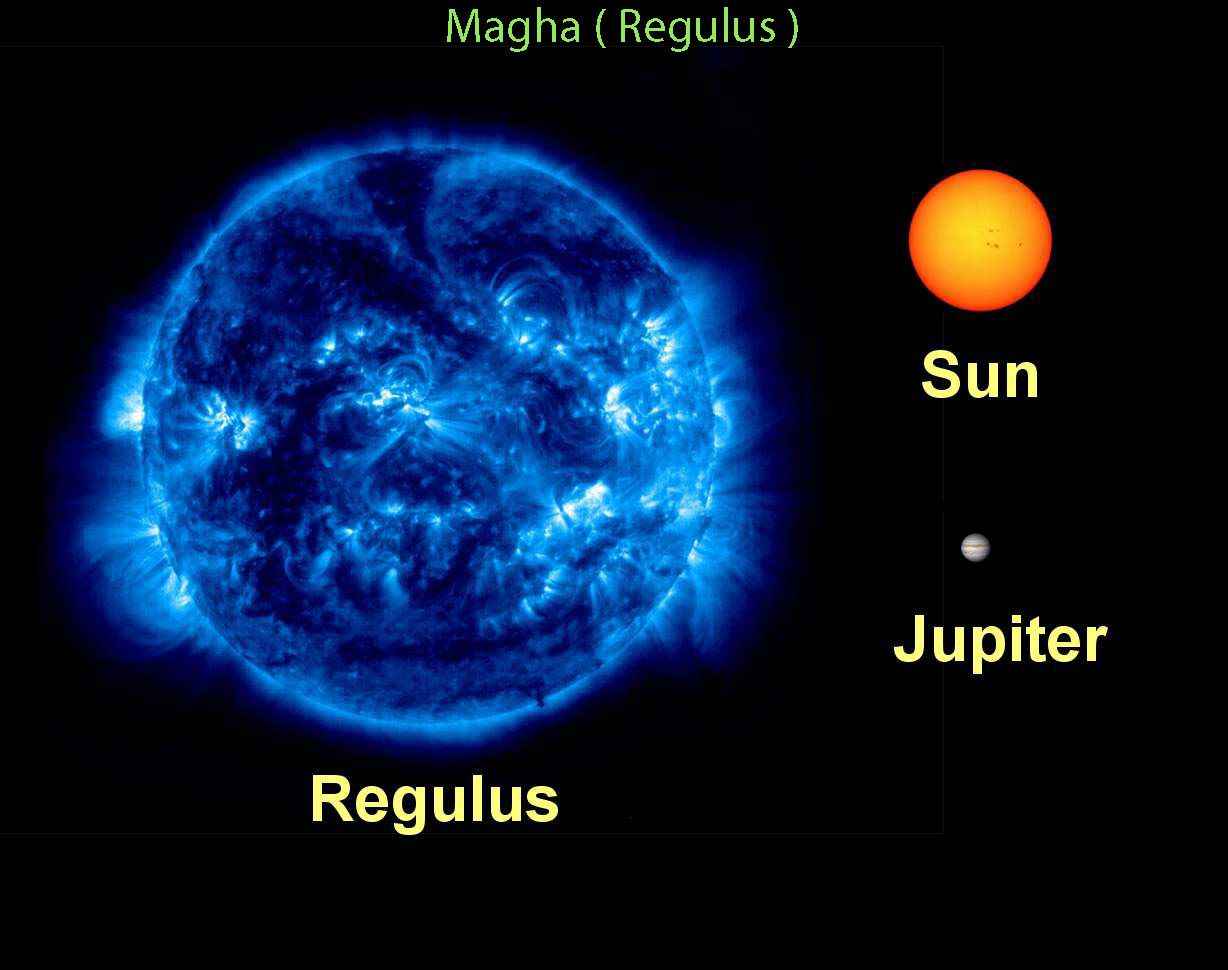
The constellation of Makha
The Pancha Siddhandhika, The Five Major Astronomical Treatises
Aryabhata, the astronomer-mathematical, integrated Five Astronomical Works - Soorya Siddhanta, Paulasa Siddhanta, Romaka Siddhanta, Vasishta Siddhanta and Paitamaha Siddanta - and called it the Panch Siddhantika. He also wrote books on Hora ( Astrology ) and Samhita ( Philosophy ). Of them, the Suryasiddhanta, which he regarded as the most accurate, underwent revisions from time to time and continues to be an important text for computing Ephemeris or Panchangas, part of the Eternal Astro Physics, Sanatana Jyothish.
Line wrap
The 7th century astro mathematician Brahmagupta's contribution was the equation for solving indeterminate equations of the second order , which surfaced in Europe later as the Pell's equation. His lemmas in this connection were rediscovered by Euler (1764) and Lagrange (1768). Brahmagupta was also the first to enunciate a formula for the area of a rational cyclic quadrilateral. In the latter half of the first millenium A.D. there were other noted astronomers and mathematicians like Bhaskara I, Lalla, Pruthudakasvamin, Vateshvara, Munjala, Mahavira (Jaina mathematician), Shripati, Shridhara, Aryabhatta II , and Vijayanandin. The tradition of astronomy and mathematics continued unabated - determination of procession of equinoxes, parallax, mean and true motions of planet, permutations and combinations, solving quadratic equations, square root of a negative number and the like.
The decimal place value system established by about the 4th century ACE, using nine digits and zero, Says famous historian of science, George Sarton, "Our numbers and the use of zero were invented by the Hindus and transmitted by Arabs, hence the name Arabic numerals which we often give them.' Brahmagupta's Brahmasphuta Siddhanta and Khandakhadyaka were also rendered into Arabic in the 9th-10th century. The Brahmi numerical forms with some modifications along with the decimal place-value system developed in India have since become universal."
Eirik L Harris averred that "Additionally, the Vedics, who developed the Hindu-Arabic number system, were far enough advanced in mathematics to make many calculations, including that of the complete cycle of the progression of the equinoxes, though, again, as the Vedas were mainly religious, there is no mention as to how results like this were derived. Overall, the Vedic culture was very rich in astronomical thinking, and it is a shame that non religious texts did not last through the centuries, for they could have shone more light on the matter of the astronomical accomplishments of the Vedic people."
The ancient eternians ( Sanatanis ) divided the path of the moon into 27 equal parts called Lunar Mansions or Nakshatras, showing the variation of the relative position of the moon in comparison to the rest of the stars visible to the eternians. The extent of the Nakshatra was 13 degree 20 minutes. These Nakshatras were quite important for determining times of the year, as can be seen in combination with Vedic Philosophy & Mythology, and can also be used to determine how far back in history Vedic astronomy extended.
The determination of the age of Eternal Astronomy or Siddhanta and the different periods of the year was represented by the myth of the god Janus.. Janus had four heads, each of which represented a phase of the Moon in Sagittarius (one of the Nakshatras) which marked the four seasons. One head was the Full Moon (in Sagittarius) which gave the time of the spring equinox, another was the new moon, during which time the autumn equinox fell, still another was the half waning moon, marking the winter solstice, and finally came the head representing the half waxing moon, during which time came the summer solstice. From current knowledge of the movement of the sphere of stars surrounding the earth, it can be calculated that the observations leading to the myth of Janus were made around 4000 BC. Additionally, within the Rg Veda is a verse observing the winter solstice in Aries, which would have placed it at around 6500 BC.
|
|
It is possible to date the Rg Veda like this because a complete cycle in the procession of the equinoxes takes place either every 25,920 years according to modern astronomers (the exact time period is still disputed by modern day astronomers), meaning that the moon is only full in Sagittarius during the spring equinox every 25,000 years or so. Modern astronomers, however, were not the first to make the difficult calculations to discover the length of this cycle. The Vedics were able to do this and came up with the value of 25,870 years and it differed from the modern value of 259250 by just 500 years. . How these eternians were able to make these calculations, however is "as great a mystery as the origin of life itself".
Further observations which could only have taken place around 4000 BC have also been recorded. These included the constellation Hydra, the Deity of Darkness. The only time Hydra was fully visible to the people of northern India was in mid-winter, when the sun shone the fewest hours, hence the allusion to the Deity of Darkness. More importantly, however, was the fact that the rains came when Hydra ceased to be completely visible. This was very important to the farmers of North India, for they needed to know when the rains would come, so as to know when to prepare their fields and plant their crops." ( Astronomy of Vedic India )






https://ajiio.in/woslXgV